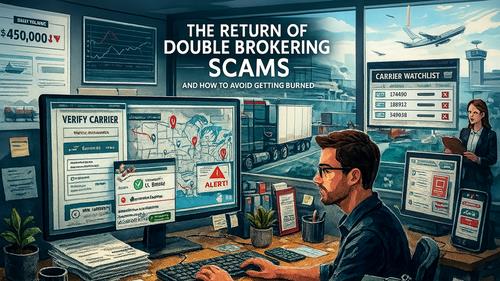
The freight world has seen scams before—but few have spread as fast or cost as much
as the double brokering scam. It’s back in full force, only now it’s slicker, faster, and
harder to spot. If you’ve been in this business long enough, you’ve probably heard the
horror stories: a load vanishes, a carrier isn’t paid, or a broker is left holding the bag with
both the shipper and the carrier demanding answers.
In 2025, the resurgence of double brokering has turned into a daily risk for freight
brokers, carriers, and even factoring companies. And while technology has made
dispatching and booking easier than ever, it’s also created new blind spots that
fraudsters are exploiting.
Let’s break down what’s happening, why this problem is exploding again, and what you
can do to keep your operation safe.
Table of Contents
- What Happens in a Double Brokering Scam
- Why Double Brokering Scams and Load Board Scams Are Spiking Again in 2025
- The Human Cost Behind Double Brokering Scams
- How Scammers Use Carrier Identity Theft to Look Legit
- Spotting Red Flags to Prevent Double Brokering and Freight Fraud
-
Freight Fraud Prevention: How to Protect Your Brokerage from Double Brokering
- Verify every new carrier
- Use consistent documentation
- Control who you pay
- Build a strong no-buy list
- Require proof along the route
- Have an incident plan
- Carriers Aren’t Immune: Avoid Getting Burned by Double Brokering Scams
- What Technology Can (and Can’t) Do to Stop Freight Fraud and Load Board Scams
- Why Verification Protects Your Brokerage from Double Brokering Scams
- How the Industry Is Responding to Double Brokering and Load Board Scams
- The Bottom Line: Preventing Double Brokering Scams and Freight Fraud
What Happens in a Double Brokering Scam
At its simplest, double brokering occurs when a carrier—or someone pretending to be
one—accepts a load from a broker, then re-posts that same load under another name.
They hire an unsuspecting carrier to haul it, collect the payment from the broker, and
disappear before the real carrier ever gets paid.
In many cases, the first carrier isn’t even real. Scammers steal legitimate carrier identities,
set up fake emails, spoof phone numbers, and create cloned insurance certificates. It’s
professional-level impersonation, and the victims often don’t realize it until the load has
already delivered.
Here’s the usual chain of events:
-
A broker posts a load online.
-
A scammer posing as a carrier accepts it using a stolen MC number.
-
The scammer re-brokers the load to another carrier.
-
That carrier hauls and delivers the freight
-
The scammer invoices the broker, gets paid, and disappears—leaving the real
carrier unpaid.
The end result? The broker’s relationship with the shipper suffers, the legitimate carrier
is angry (and unpaid), and the authorities rarely recover the funds.
Why Double Brokering Scams and Load Board Scams Are Spiking Again in 2025
Several trends are fueling the current wave:
-
Economic pressure:
As margins shrink and volumes fluctuate, desperation
grows. Scammers exploit that urgency.
-
Digital overload: Load boards and online dispatch platforms have made freight
accessible to anyone, but also created more anonymity.
-
Speed culture:
The faster brokers try to book freight, the more verification steps
get skipped.
-
Identity theft made easy:
Fake COIs, cloned MC profiles, and matching Gmail
addresses can be created in minutes.
-
Remote work:
More brokers and dispatchers working off-site means less
oversight and more opportunity for fraud to slip through.
Fraud rings are organized now. They operate like businesses—using multiple phones,
addresses, and fake documents to juggle dozens of loads at once. Some even
impersonate legitimate factoring companies to get early payment.
The Human Cost Behind Double Brokering Scams
Every scammed load is more than just a line item. It’s a carrier who burned fuel and time
without pay. It’s a broker facing chargebacks and lost shipper confidence. It’s a ripple
that damages trust across the entire transportation network.
In one case reported earlier this year, a small brokerage lost over $40,000 in a single
week to a ring that spoofed legitimate MC numbers from different states. The scam was
only caught when a carrier called to ask why their invoice hadn’t been paid.
The truth is, most victims don’t report it—partly from embarrassment, partly because
they assume law enforcement won’t recover the funds. That silence makes it easier for
the next scammer to move on undetected.
How Scammers Use Carrier Identity Theft to Look Legit
What makes double brokering dangerous is how believable it all looks on the surface.
You’ll see:
-
COIs that appear professionally formatted.
-
Dispatchers who respond quickly and know your lanes.
-
Driver details that check out—sometimes even real drivers who were duped
themselves.
-
Banking and factoring information that seem plausible.
They know exactly how brokers vet carriers—and they mimic that process to a T.
A broker in Florida recently shared how they received a COI with a real agent name, real
limits, and even the agent’s logo. The only problem: the phone number led back to a
burner line. The fraudster had copied an authentic insurance certificate but swapped the
contact details.
Spotting Red Flags to Prevent Double Brokering and Freight Fraud
You don’t have to be an expert to catch early warning signs. You just need to slow down
enough to look.
Watch for:
-
Emails from free domains (Gmail, Yahoo, Outlook) or that don’t match the carrier
name.
-
Phone numbers that differ from those listed on FMCSA or insurance documents.
-
Carriers that accept loads unrealistically fast or agree to rates without hesitation.
-
Mismatched addresses between the W-9, FMCSA profile, and factoring
paperwork.
-
Carriers requesting payments through Zelle, CashApp, or accounts that don’t
match their legal name.
- New MCs claiming to have long histories in your lanes.
When two or three of these appear together, stop and verify before dispatch.
Freight Fraud Prevention: How to Protect Your Brokerage from Double Brokering
You can’t eliminate all risk, but you can make yourself a hard target
-
Verify every new carrier
Check MC/DOT numbers, call the insurance agent listed on the FMCSA record (not on
the COI), and confirm contact information. If anything doesn’t align, move on.
-
Use consistent documentation
Never accept screenshots or low-quality scans. Ask for PDFs and verify digital signatures
when possible.
-
Control who you pay
Pay only the carrier on your rate confirmation or their approved factoring partner. Never
change payee information without written verification and management approval.
-
Build a strong no-buy list
Key it to MC numbers—not just names—and make sure your entire team uses it. Update
it weekly.
-
Require proof along the route
Ask for driver IDs, truck/trailer numbers, and photos of pickups. Require PODs that
include timestamps and receiver details.
-
Have an incident plan
If you suspect a scam, freeze payment immediately. Contact the shipper, confirm the
delivering carrier, preserve all communication, and alert your insurer and law
enforcement if needed.
Carriers Aren’t Immune: Avoid Getting Burned by Double Brokering Scams
Carriers get burned too—especially small fleets that rely on quick pay.
If you’re a carrier:
-
Confirm the broker’s MC authority and bond through FMCSA or TransCredit
before hauling.
-
Make sure the name on the rate confirmation matches who you negotiated with.
-
Watch for reposted loads from multiple brokers.
-
Never accept “split pay” arrangements unless verified through your factoring
company.
-
Protect your digital identity—use MFA on emails and never post full documents
publicly.
When in doubt, call the shipper or original posting source to confirm who actually
booked the load.
What Technology Can (and Can’t) Do to Stop Freight Fraud and Load Board Scams
Many TMS platforms and credit bureaus now flag suspicious carriers or repeated
identity inconsistencies, but even the best systems rely on clean data. Verification isn’t a
one-time process; it’s ongoing.
Integrating real-time credit and payment data, like what TransCredit provides through
APIs and partner portals, can expose patterns before they cause losses. For example, if a
carrier’s payment behavior suddenly changes, or their address is tied to multiple
unrelated MCs, those are strong fraud indicators.
Still, no platform can replace human awareness. Technology is your safety net—your
team’s discipline is the parachute.
Why Verification Protects Your Brokerage from Double Brokering Scams
In transportation, reputation is currency. When a shipper’s load goes missing or unpaid,
they don’t just blame the fraudster—they blame the broker who tendered it. A single
double-brokering incident can cost a customer relationship years in the making.
That’s why consistent vetting matters. It’s not about paranoia—it’s about
professionalism. Every verification step signals to your shippers, carriers, and factoring
partners that your business takes integrity seriously.
How the Industry Is Responding to Double Brokering and Load Board Scams
Major load boards, factoring companies, and credit bureaus are finally tightening their
screening processes.
-
Load boards are flagging suspicious postings tied to duplicate MCs.
-
Factoring firms are cross-checking carrier identities before purchasing invoices.
-
Credit reporting companies like TransCredit are introducing deeper payment
trend analysis and fraud markers.
But the industry still relies heavily on communication. When brokers share scam details
and carriers report suspicious behavior, the entire ecosystem becomes safer.
The Bottom Line: Preventing Double Brokering Scams and Freight Fraud
Double brokering isn’t new—it’s just evolved.
The freight economy is still adjusting after years of volatility, and scammers know exactly
where to strike. But they depend on confusion and speed. Every time a broker pauses to
verify, they lose power.
In an era when digital connections define freight movement, trust has become your
most valuable asset. Protect it relentlessly. Verify every load. Document every
transaction. And when something doesn’t feel right—walk away.
Because getting burned once is painful.
Getting burned twice means you weren’t paying attention.
For more information, please reach out to us.